


- October 22, 2026
- by
- Uncategorized
- 3 Comments
You check your analytics every week. You track your ad performance, your website traffic, and your social media reach. But what if a large part of your sales are coming from conversations you cannot see at all?
This is called Dark Social — and most enterprise brands have no idea it is happening.
What is Dark Social?
Dark Social refers to traffic and conversations that happen in private digital spaces. These are places where your standard analytics tools cannot track anything.
Examples of Dark Social include:
- Someone sharing your website link in a WhatsApp group
- A manager forwarding your blog post to their team on Slack
- A customer recommending your brand in a private Facebook group
- A colleague sharing your LinkedIn post via direct message
- Someone copying and pasting your URL into an email or text message
All of these happen every single day. And none of them show up in your Google Analytics as social media traffic. They appear as direct traffic — as if the visitor simply typed your URL into their browser for no reason.
Why Does This Matter for Enterprise Brands?
Here is the reality. Studies show that up to 84% of all online content sharing happens through private channels — not public social media posts. That means for every person who shares your content publicly on LinkedIn or Twitter, around five more people are sharing it privately where you cannot see it.
If you are making marketing decisions based only on what your analytics can track, you are working with an incomplete picture. You might be cutting budget from a campaign that is actually driving significant word-of-mouth. You might be undervaluing your best content. You might be missing your most effective channel entirely.
How Dark Social Actually Drives Sales
Dark Social is not just casual sharing. It is often the final step before a purchase decision.
Think about how enterprise buying decisions actually happen:
- A marketing director reads your blog post and shares it in a leadership WhatsApp group
- The CEO opens it, reads it, and visits your website directly
- A week later the company contacts you for a proposal
Your analytics shows this as a direct website visit with no source. You have no idea that your blog post started the entire conversation. This is Dark Social driving real business — completely invisible to your reporting.
Signs Dark Social is Already Working for Your Brand
You may already be benefiting from Dark Social without knowing it. Look for these signs:
- A high volume of direct traffic that does not make sense — people arriving with no clear source
- Leads mentioning they “heard about you from a colleague” but cannot remember exactly where
- Blog posts or videos performing well in terms of time-on-page but showing low social shares
- New clients saying things like “we had been following you for a while”
- Spikes in direct traffic after you publish new content
If these sound familiar, Dark Social is likely already driving meaningful traffic to your business.
What Enterprise Brands Should Do About It
You cannot fully track Dark Social — that is its nature. But you can create conditions where it happens more, and you can measure its effects more accurately.
1. Create Content That People Want to Share Privately
Dark Social sharing is driven by content that feels genuinely useful, surprising, or exclusive. Data-backed reports, honest industry insights, and practical how-to content get shared in private groups far more than promotional material. Focus on creating content your audience would want to send to a colleague with the message “you need to read this.”
2. Use UTM Parameters on Every Link
When you share your content anywhere — email newsletters, social media posts, paid ads — always use UTM tracking links. This helps you separate genuinely direct traffic from content that was shared privately but originally came from a trackable source.
3. Ask Your Leads How They Found You
Add a simple question to your contact form or sales calls — “How did you first hear about Novus Engage?” The answer will often reveal Dark Social channels that your analytics completely miss. This is old-fashioned but extremely effective for enterprise brands.
4. Build Private Community Spaces
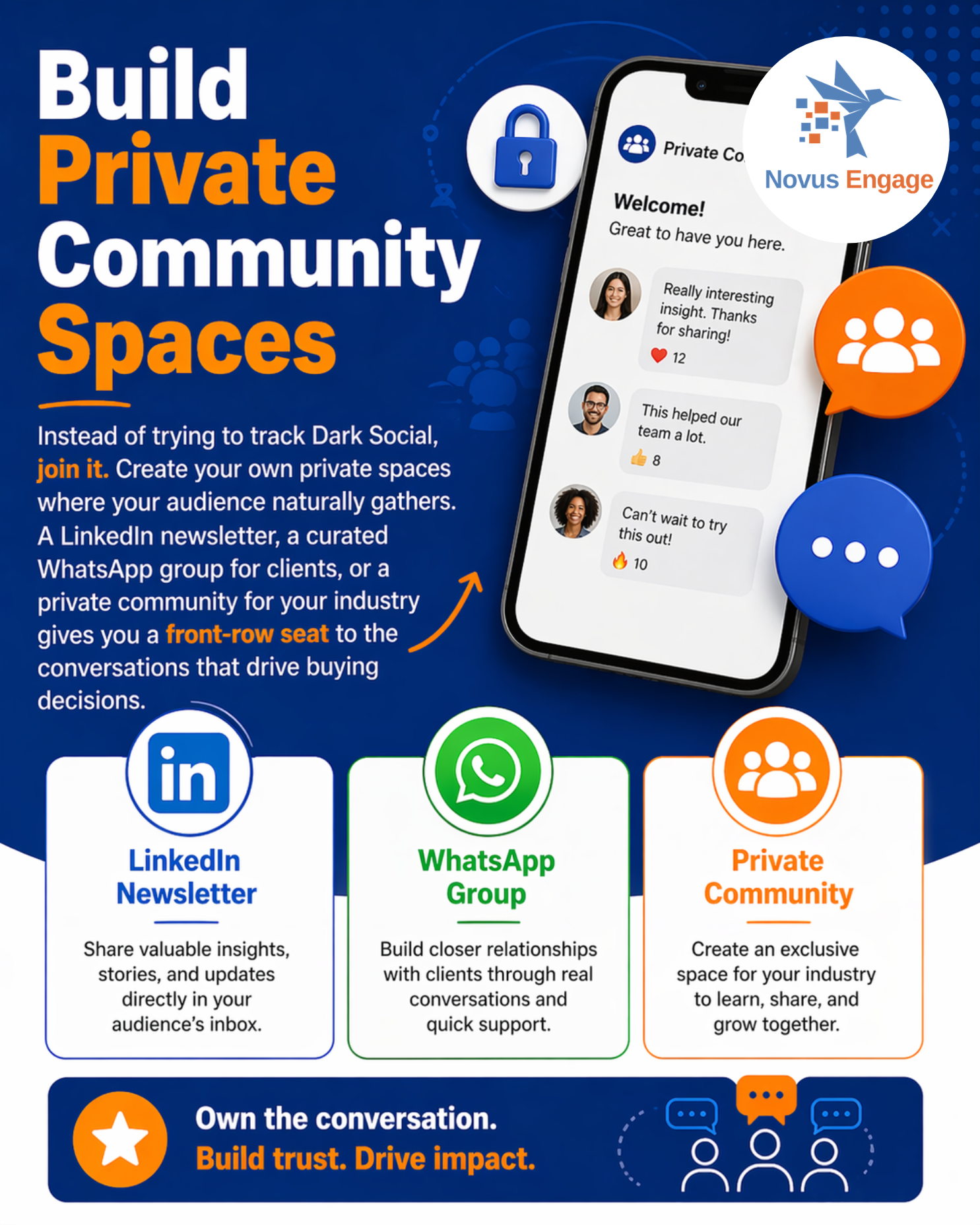
Instead of trying to track Dark Social, join it. Create your own private spaces where your audience naturally gathers. A LinkedIn newsletter, a curated WhatsApp group for clients, or a private community for your industry gives you a front-row seat to the conversations that drive buying decisions.
5. Invest in Content Worth Sharing
The single most effective Dark Social strategy is simple — create content so genuinely useful that people cannot help but share it. Case studies with real numbers. Reports with original research. Honest takes on industry challenges. This is the content that travels through WhatsApp groups and Slack channels and drives the kind of word-of-mouth that no ad budget can buy.
The Bottom Line
Dark Social is not a new concept. But in 2026, as more conversations move to private channels and messaging apps, it has become one of the most important — and most underestimated — drivers of enterprise sales.
Your customers are talking about your brand in places you cannot see. The brands that understand this, and create content worth talking about, are the ones that grow fastest.
Stop optimising only for what your analytics can measure. Start creating for the conversations you cannot see.
Contact Novus Engage to learn how we help enterprise brands build content strategies that drive real word-of-mouth growth in 2026.
Comments (03)